Pop Yeh Yeh Music in 1960s - 1970s Singapore
Done for: HH2001
The Making of a Cosmopolitan City-State
Done by:
Glenna Tan
Benjamin Ho
Chong Kit Yen
Danielle Tan Xinyi

WHAT DEFINeS

Pop Yeh Yeh music is classified as rock n’ roll sung in Malay which was inspired by the British rock n’ roll movement which started in the 1950s (Buang 2001, 1). Essentially, if you attempt to search for “Pop Yeh Yeh” in the Singapore archives, you will likely find little to no results. Hence, it is important to note that this term might not have been formally known as Pop Yeh Yeh until the 80s (Lim 2009). Nonetheless, there is a newspaper article that contains the term “Pop Yeh Yeh” or the words “Yeh Yeh” published in the 1960s. Hence, it is difficult to ascertain when exactly this term was coined or used. Other terms to refer to this genre of music include: “pop melayu” (Malay pop, Malay Popular Music) and “Beatles bands”.

“Angkatan Pop Yeh Yeh di-Stadium Negara” (“The Pop Yeh Yeh movement at the Stadium Negara”) - published by Berita Harian on 9th April, 1967 which writes about a music performance at the Kuala Lumpur Stadium Negara (National Theatre)
Although rock n' roll culture had already begun to proliferate in the earlier decade and local bands existed, it was not until the Cliff Richard and The Shadows concert at Singapore’s Happy World Stadium in 1961, that rock n’ roll gripped the youth of Singapore like never before (Lim 2008).
Some other popular Western music idols which the Singaporean Malay youth looked up to include The Beatles, Elvis Presley, The Ventures and The Rolling Stones (Dairianathan and Phan 2005, 4; 184; Fernandez 2021).

Cliff Richard and the Shadows Concert, end of 1961, Singapore
The excitement of that night spurred youths to form bands.
In addition, that legendary performance inspired traditional Malay kugirans (Bands, Malay musical groups or guitar ensemble) to change their lineup
(Buang 2001, 4).

Who?
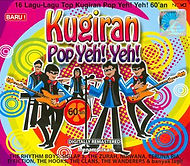
Typically, Pop Yeh Yeh bands consisted of: a lead guitarist, a rhythm guitarist, a bass guitarist and a drummer- and they would be fronted by a singer (Dairianathan and Phan 2005, 184). To name a few popular ones, there were The Rhythm Boys, Jeffridin and The Siglap Five, Kassim Selamat and The Swallows, Impian Bateks and Zam Zam and The Twilites.
Aside from these bands, there were singers who recorded solo backed by those bands. For example, Siti Zaiton released her first EP in 1967 and subsequently collaborated with various bands including The Twilites and The Hornets (Pereira 2014, 83-84). Other popular female artistes include Fatimah M Amin, Rafeah Buang and Kartinah Dahari.
Siti Zaiton and The Twilite’s vinyl record released in 1970.
When?
The rock n’ roll movement hit in the 1950s, but properly kicked off in Singapore during the aforementioned 1961 Cliff Richard and the Shadows show. Subsequently, the 60s saw an emergence of bands in the local music scene which include the Pop Yeh Yeh bands. These Pop Yeh Yeh bands truly excelled after 1965, when record labels such as Phillips and Times/Olympic began scouting and signing Pop Yeh Yeh bands, producing records and EPs. Pop Yeh Yeh eventually died down in the early 1970s, seemingly due to new government measures and policies in the aims of modernising Singapore.
What?
At this point, the earliest Malay bands were mainly playing covers of their favorite English songs translated into Malay. However, the Pop Yeh Yeh genre was only truly born in 1963, when M Osman (and the MODs) wrote their very first original titled, “Suzana” which was the song that came to define this style of Malay pop music (Pereira 2014, 21). Most of the Pop Yeh Yeh songs revolved around themes such as heartbreak, love and youth.
Aside from the music genre, the Pop Yeh Yeh craze can also be attributed to the daring and stylish outfits which resembled the likes of The Beatles. Musicians and singers of Pop Yeh Yeh could often be found in bright, colourful outfits and it was common for the men to don tight pants and black leather boots. A well known fashion feature that emerged later on was the men’s iconic long hair (hairstyles which resembled that of the Beatles members), which was soon banned by the Singapore government.

Many of these Malay bands originated from the eastern side of Singapore: Geylang, Kaki Bukit, Jalan Eunos and Siglap (Dairianathan and Phan 2005, 186). However, the centre for band gatherings and practices was undeniably Geylang Serai.
Pop Yeh Yeh bands were in high demand and they performed at various spaces. These include regular band practices in the kampong (Geylang Serai), weddings, events, clubs, tea dances and also in the theatres. Naturally, the popularity of this genre also propelled the bands to perform on radio, television shows and even star in films. Malay bands would be paid from $100-$200 per performance (The Rhythm Boys were paid $300 per wedding) and the amount varied depending on the venue and event (Buang 2001, 10 ; Taib 2021).
In particular, tea dances were a common venue for the Pop Yeh Yeh bands. These tea dances mostly took place at clubs, such as the renowned club in Orchard Road named The Golden Venus. These music gatherings would charge an entrance fee (ranging from $3 to $10) be held on afternoons over the weekend and no alcohol would be served due to under-aged patrons (Pereira 2011, 6). These tea dances were similar to our contemporary clubs, but were mostly frequented by the wealthier class, especially the British (Taib 2021).
where?

Photos of Gelyang Serai Kampongs
in the 60s

“A brew in search of a new infusion” The Straits Times, 21 May 1989, Page 3
WHAT HAS BEEN WRITTEN?
“Pop Yeh Yeh in Singapore: 1963-1971” Burhanudin Bin Buang

Buang's thesis discusses the sociological, cultural and political effects that affected the rise and decline of Pop Yeh Yeh. He mentions a lack of proper research and in this particular subject and highlights Pop Yeh Yeh's unique Singaporean nature and identity.
In short, Buang demonstrates the similarities in Singapore's stories as a new and growing nation state and the Pop Yeh Yeh trends.
"Beyond the Tea Dance" 2014 Joseph Pereira
Joseph Pereira is one of the most prominent authors who has written extensively on the history of Pop Yeh Yeh in Singapore. His other works include "Apache over Singapore" and "Legends of the Golden Venus" which focuses on the overall 60s music boom in Singapore.
Pereira's book gives great insight on the creation of these Pop Yeh Yeh bands and also provides a clear list of the most popular bands in that era.
Dairianathan, Eugene and Phan Ming Yen. “Music Practices; Pop Yeh Yeh” in A narrative history of music in Singapore 1819 to the present. Singapore: 2005.


Dairianthan and Phan also provide a rich account on the social and cultural factors that affected Pop Yeh Yeh. They document the rise and fall of the genre, along with reasons for the resurgence in the 1980s.
They highlight the characteristics of Pop Yeh Yeh bands, as well as provide an interesting perception of criticism by other musicians within the Malay community which complements other sources (such as Johan) which highlights similar tensions.
“Disquieting Degeneracy: Policing Malaysian and Singaporean Popular Music Culture from the mid-1960s to early 1970s.” In Sonic Modernities in the Malay World: a history of popular music, social distinction and novel lifestyles (1930s-2000s). Edited by Bart Barendregt. Boston: Brill, 2014. - Johan, Adil.

Johan analyses the relationship between the different parties in the Pop Yeh Yeh context. For example, he highlights the tension between the Pop Yeh Yeh bands/fans and the Singapore government. Additionally, he highlights the older generation's conservative sentiments and hence, skeptical view of Pop Yeh Yeh.
Johan delves into the nuances behind the Pop Yeh Yeh trend and emphasises on the anxieties of the government which can be observed in the policies and regulations they set,

WHAT WE DISCOVERED
The enduring nature of the Pop Yeh Yeh movement & its significance in SG
Despite major political shifts in 1965 when Singapore was separated from Malaysia, Pop Yeh Yeh kept going strong, with bands performing in both countries and even in Brunei (Taib 2021). Nonetheless, they were still affected by this major change and their concerns were reflected in their music of that time. (Buang 2001, 15)
Furthermore, Singapore was considered the centre of the Pop Yeh Yeh industry as majority of the recording companies which produced albums for this genre were located here and it served as the locus for Malay popular entertainment (Dairianathan and Phan 2005, 185).

Intermixing between the Malay and English circuits
Although most of the singers of Pop Yeh Yeh were Malay, the musicians were not. For example, Anita Sarawak and The Silver Strings, Siti Zaiton and The Firebyrds, Andy Lim and The Swallows as well as Veronica Young and the Impian Bateks during a tour in South Vietnam 1969.
In an interview with Ali (leader and bassist of The Rythmn Boys), he also acknowledges that the Pop Yeh Yeh bands were good friends with other English-speaking bands. Furthermore, the first person who signed The Rythmn Boys with Olympic was a Chinese man, Mr Ang (Taib 2021).
With the remarkable amount of collaboration between the different races and languages, it is clear that the genre of Pop Yeh Yeh transcended racial and vernacular boundaries. Hence, although Pop Yeh Yeh is clearly a Malay genre, the people who played a role in the rise of this genre were definitely not confined to the Malay community.
Overall lack of research and focus
Similar to what Buang has stated in his thesis, there is an overall lack of proper academic research on the Pop Yeh Yeh trend in Singapore.
Understandably, the term might have been coined only in later years. Yet, in the search for a deeper meaning and consequence of Pop Yeh Yeh, we have realised that this genre was significantly more popular and impactful that initially expected.
Ali from The Rythmn Boys take us through his days as a band member, with crowds of groupies fawning over them. He also shares that the Singaporean Pop Yeh Yeh bands were extremely well received in Malaysia and Brunei. This, along with the amount of money they earned in those days, hints that there is so much more behind the genre to uncover.


Perception by Malay community
Pop Yeh Yeh music was well received to a large extent. According to Ali, the Malay community generally liked Pop Yeh Yeh music as lyrics were mainly about love, heartbreak, life, and other meaningful themes, unlike the “rock” music which largely circulated around drinking and drugs. Some of these love songs include the aforementioned “Suzana” by M Osman, and “Oh Fatimah” by A. Ramlie and The Rhythm Boys.
In regard to fashion, Ali added that the Malay community thought the suits made them look presentable. Furthermore, there was a demand for this genre of music within the community- one example being their essentiality in Malay Weddings. Getting a Pop Yeh Yeh band to play at your wedding was seen as “trendy” and it was the “in” thing in the 1960s. Another aspect which reflected the reception of this music genre was the fact that many Pop Yeh Yeh songs hit the Malay charts such as A. Ramlie’s “Oh Fatimah” (1966) and “Kenangan Mengusek Jiwa”. Another legendary song was “La-A-Obe” by Kassim Selamat and The Swallows which not only made it to the Malay charts, but was popular overseas on a German radio program where it stayed in the top ten for three weeks.
Getting a Pop Yeh Yeh band to play at your wedding was seen as “trendy” and it was the “in” thing in the 1960s (Pereira 2014, 14). Another aspect which reflected the reception of this music genre was the fact that many Pop Yeh Yeh songs hit the Malay charts such as A. Ramlie’s “Oh Fatimah” (1966) and “Kenangan Mengusek Jiwa”. Another legendary song was “La-A-Obe” by Kassim Selamat and The Swallows which not only made it to the Malay charts, but was popular overseas on a German radio program where it stayed in the top ten for three weeks.
Furthermore, residents living in the same Boyanese village as the band members would go “berserk” whenever The Swallows’ “La-A-Obe” or “Angkok Angkok Bilis” played on Malay radio. To them, it was a win for the community and a moment of pride (Pereira 2014, 14).
In the 1960s, the Malay community in Singapore had not yet seen the religious resurgence of the Dakwah Movement so the community was generally more open to the Western cultures and fashions adapted by Pop Yeh Yeh groups.
Perception by youth + fan culture

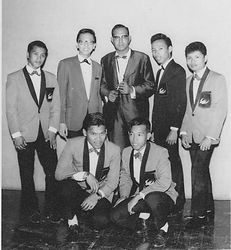
The Siglap Five decked out in their suits and ties

The young Rythmn Boys
The main consumers of Pop Yeh Yeh music and culture were the Malay youth, adults and children (Dairianathan and Phan 2005, 187). However, this doesn’t mean that this stream of music was confined to the Malay community. In fact, youths from other ethnic backgrounds were also familiar with the Malay bands and music (Conceiacao 2009).
Jerry Fernandez, singer and leader of the Neu Faces (an English band), recalled listening to Pop Yeh Yeh groups while he was growing up such as Kassim Selamat and the Swallows, Impian Bateks as well as A. Ramlie and The Rhythm Boys who he says are “bloody gifted”. He would attend Malay Weddings to hear them play and Pop Yeh Yeh music would also be played over radio programs such as Pesta Pop (‘Pop Party’) and Penyanyi Pujaan Minggu Ini (‘This Week’s Most Popular Singer’). These activities were common among the Pop Yeh Yeh fanbase and some other outlets they tuned into were local television programmes where Singaporean music groups appeared, records and concerts. These performances were usually held at the National Theatre among others and were sold out affairs. There would also be an overflow crowd who peered through fences and some who would even climb up in trees to watch the performances (Conceiacao 2009, 5).
Young audiences also emulated the Western fashions and trends which their favourite local bands followed. They dressed in “outrageous” and “provocative” ways such as women in short mini-skirts and figure-hugging cuts while men wore tight, slim trousers and kept long hair.
It was typical for followers of Pop Yeh Yeh to “mob” the Malay bands- just like those seen in Western music cultures today (Taib 2021). Ali also shared that fans were “crazy”- some of them cut off his hair and kept it as souvenirs and once, a fan followed him home.

The significance of radio in accessing music: the logo of Radio & Television of Singapore after separation from Malaysia, 1965.
Opposition in society
Nonetheless, this music culture was not short of antagonistic figures, consisting of older generation professional musicians and peers from the Malay community. Some criticized the quality and style of playing while others targeted the “degenerate” Western elements and fashion trends. A number of these individuals include: Horace Wee, Sam Gan,, Zubir Said and even P. Ramlee himself.
“...it became a big shock to the professional musicians [like us] of the previous twenty/thirty years....and of course it was greeted with great resentment…”
Interview with Horace Wee (Saxophonist, Guitarist and Music Guru) and Sam Gan (Singaporean Pianist)
“…this kind of music placed importance only on the loudness of the music rather than the quality of the song itself...Poor quality pop songs and music will give rise to a future generation that is wild. Young people who sing as they please, play music as they please, dress themselves as they please will end up exposed to negative elements which will inevitably result in all ill discipline.”
P Ramlee after the release of M. Osman’s “Oh Suzana” in 1963
Parents, yay or nay?

There was generally a mixed response in this area as well. Some parents were open and supportive of their children pursuing their music passions and even funded all their equipment such as The Rhythm Boys and The Bateks (Pre-Impian Bateks days) (Taib 2021; Pereira 2014, 31). Well-off families with bigger kampung houses also allowed their children to rehearse within the household- this was true for The Bateks.
However, on the other extreme end, there were families who were stricter about their children dabbling in music as rock n’ roll was commonly associated with anti-social behaviour such as long hair, hippie culture, drugs, sex, smoking and alcohol (Conceiacao 2009, 7). In these instances, band boys had to go “underground” and practice in secret, trying to best avoid the watchful eyes of teachers and parents.
Someone who experienced this was the singer of The Rhythm Boys, A. Ramlie, who had to rehearse behind his parent’s backs because they were really strict. Even after recording his first album with two songs which hit the charts, his father retorted- how could he be a recording artiste when he sounds like a frog (Pereira 2014, 38)! So here we have two sides of the coin.
Government Anxieties & Nation Building
The 60s was a crucial time for the Singapore government with the nation’s newfound independence in 1965. During this period, the authorities aimed to cultivate a new national identity which was “refined in modernity yet rooted to indigenous traditions” and they wanted to prioritize and preserve “Asian” values over others (Johan 2014, 144). However, this emerging localised Western youth culture (not just the Malays) was “far from refined” and it adapted and celebrated foreign influences on a large scale- which was essentially the antithesis of the nation-building project (Johan 2014, 145).
In addition to anti-social behaviour which sparked “moral panics” in the Singaporean authorities, there were cases of violence which erupted at tea dances which too contributed to state anxiety. Fans who were “really hardcore” would get into fights in the audience. Once, someone was killed at the Mandarin Hotel boiler room and deaths would ensue due to issues like disagreements over choice of songs (Dairianathan and Phan 2005, 124). Gang fights also tended to take place near the scene of Tea dances- whether they were “instigated” by them, we do not know. However, such fights were commonly associated with tea dances even though they may not have been directly connected.
“Let us not consider the subject of music as a trifling matter…Neglect in Singapore on this subject has given rise to serious problems. I refer to the widespread popularity of the barbarous form of music produced by the steel guitar linked to an ear shattering system of sound amplification. Voice accompaniment takes the form of inane tasteless wailing. It is barbarous music of this kind that is mainly responsible for attracting the mindless young of Singapore to the cult of permissiveness of the western world. It is hardly a coincidence that the problem of drug-addiction has become serious where performers and audience foregather. I trust the Ministry of Home Affairs will take stern action against this menace”
(Dairianathan and Phan 2005, 401-402).
Excerpt from Dr. Goh Keng Swee’s speech in 1973

Hence, the proliferating youth trends sparked high levels of tension in Singapore’s authorities. These governmental fears and in response, desires to assert control, were reflected in the newspapers of that time.
Image the left: “Man dies in fight after hotel tea dance” published on 16th November, 1964
Image the right: “Ambassador Hotel” published the next day in reply

Perception:
How was Pop Yeh Yeh perceived?

THE DECLINE OF
POP YEH YEH
As the common saying goes, “all good things must come to an end”. Pop Yeh Yeh was no exception. Although there were various reasons for it’s decline, we have chosen to focus on the following factors:
Perception of arising youth culture
Our team defines youth culture as the social norms, behaviours and interests that people within the youth demographic were involved in.
Reason for the rise of youth culture
With the increase in availability of technology in the 1960s to 1970s, such as televisions and radios, information could be spread to a wider audience very quickly. However, this also meant that Singapore’s youth population had easier access to popular western trends without adult supervision (Buang 2001, 21-22). Hence, a bridge was built between the local youth culture and western influences.
Youth culture in relation to the ongoing ‘yellow cultures’ issues and how this affects the public views:
Youth culture had western practices similar to those found in ‘yellow culture’. For example, the act of taking drugs and wearing popular western fashion, (Johan 2014, 150). Hence, in the eyes of the public, both of these cultures were related on a fundamental level - which was based on the idea that western influences caused social disorder (Johan 2014, 150). Therefore, youth culture was negatively viewed by the state, which eventually led to the discipline of Singapore’s social behaviour norms in the hopes of sanitising this ‘yellow youth culture’.
Here are some cut-outs of newspaper articles that shows the public’s opinion and the directions planned for Singapore’s 1970s youths culture:

Fig 1: Wipe out ‘rotten aspects of Western culture, say MP’. Newspaper article, September 27, 1970. The Straits Times, NewspaperSG, Singapore.
Fig 2: MP: Idle youth dangerous source of social ferment. Newspaper article, June 14, 1971. The Straits Times, NewspaperSG, Singapore.
By the 1970s, Singapore’s society had a negative image of youth culture and was finding ways to suppress and control such activities. However, was the state successful in getting rid of youth culture? We believe that the answer is, no.
As seen in modern day Singapore, youth culture is still present. It might have evolved to adopt the new trends emerging but the tenacity of the youth culture formed in that era did not completely disappear. Hence, this cycle could have been present during the youth culture of the 1960-1970s.
Decline of Pop Yeh Yeh due to youth culture?
In relation to youth culture, Pop Yeh Yeh was a popular music genre enjoyed by the youths. However, with youth culture getting a bad reputation, bans and closure of venues frequently visited by these youth were implemented. For example, in the 1970s, the Tea Dances that were popular with the youths were closed. Coincidentally, Tea dances were also venues used by Pop Yeh Yeh bands (Johan 2014, 150). By controlling the spread of ‘yellow’ culture, Pop Yeh Yeh, which could be considered an element of youth culture, was also affected.
The Dangers of Yellow Culture
Singapore government's modernisation and sanitization
The phrase ‘yellow culture' was originally associated with pornographic culture. However, as the times changed, the meaning of the word began to encapsulate all the western influences - from the popular western fashion trend to music genres, that was deemed as harmful to society (Lau 2016, 40).
Additionally, the term was impacted by the ‘yellow’ disease which was known to the world as a virus that spread from abroad (Lau 2016, 40). By connecting the foriegn virus and foriegn influences, based on the word ‘yellow’, ‘yellow’ culture was seen as a ‘disease’ that could be detrimental and taint the people.
In Singapore’s context, ‘yellow’ culture was similarly seen as foreign/western activities that would negatively affect social standards, behaviour and image. This view towards ‘yellow’ culture could be seen in Singapore’s media.
Snippers of negative responses to ‘yellow’ and western culture published in Singapore local newspapers around the 60s and 70s:


Captions for the newspapers:
Fig 3: Eating dinner to the sound of ‘barbaric music’. Newspaper article by Alex Josey, March 12, 1973. New Nation, NewspaperSG, Singapore.
Fig 4: Govt. bands four more U.S. magazines: Yellow culture clamp continues. Newspaper article, June 26, 1961. The Singapore Free Press, NewspaperSG, Singapore.
Fig 5: Appeal to minister. Newspaper article, July 6, 1960. The Singapore Free Press, NewspaperSG, Singapore.
How did it affect Singapore’s Pop yeh yeh scene in the 1960s to 1970s?
Pop yeh yeh, along with many popular music genres, was heavily influenced by western music, specifically the British, due to Singapore's history with them (Fernandez 2021). Hence, the roots of Pop Yeh Yeh could have been a contributing factor. Generally, popular western fashion trends, such as mini-skirts, tight-skin outfits and long hair, were seen as “degenerate practices” in Singapore society (Johan 2014, 148).
However, in the 1960s to 1970s, this was the common fashion worn to Tea Dances that hosted popular bands, which included groups that performed Pop yeh yeh music. (Johan 2014, 149 - 150). Therefore, Pop yeh yeh was indirectly affected because of the elements that coincide with the ‘yellow’ practices being controlled by the state.
In the 1960s and 1970s, the modernisation of Singapore was deeply connected to westernisation and globalisation. During this period, the world was dealing with the effects of World War II and as a newly independent nation, Singapore had to quickly gain her footing to survive. Hence, government authorities undertook strategies to attract foreign talent, businesses and investors to the state’s shores to increase economic stability and growth (Low 2001, 416).
Methods, such as the enforcement of social discipline, sanitization and the urbanisation of the nation’s landscape among others, were used to create an image appealing to an international audience (Low 2001, 434). Besides projecting a desirable image on the international stage, these developments also shaped the Singaporean identity and sparked new social policies within the country (Chua and Kuo 1991, 105). Hence, modernisation in Singapore focused on employing methods to attract a global audience for survival as a new nation.
Modernization of infrastructure: building of HDBs, demolishing of kampungs and the clampdown on popular tea dance venues
To ensure Singapore’s survival, the government decided that modernisation was essential. In the process of development, infrastructure was used as a tool to portray Singapore as a modern society. The renovation and budding of new housing could be seen as a part of these plans. Additionally, the country was facing a population issue - there were too many people and not enough homes.
Hence, in the 1960s, the Housing Development Board (HDB) flats were built to solve the high demand for housing (Housing and Development Board 2020, 17-18). HDB flats were just the start, as seen in the Urban Redevelopment Authority’s master plan (a long term urban plan) for Singapore in 1958.
Click on the link to explore the interactive map/master plan of the 1958: https://www.ura.gov.sg/dc/mp58/mp58map_index.htm
As you can see, there were plans for modern infrastructures such as clinics, schools, shopping centres, means of public transportation and many more (Urban Redevelopment Authority [URA] 2021a). By the 1980s, much of the land was used for Singapore’s modern transformation (URA 2021b).
Click on the link to explore the interactive map/master plan of the 1980s: https://www.ura.gov.sg/dc/mp80/mp80map_index.htm
With Singapore being a little red dot, land is very limited. Hence, the demolition of kampung areas had to be done to make way for the new housing and purposeful structures. By demolishing the kampung areas and old buildings, it severely affect the Pop Yeh Yeh bands. As recounted by Mr Ali, this new urban landscape meant that they could not play as loudly or as long as they wanted (Taib 2020). This change in infrastructure was detrimental to the bands’ ability to practice.

How did the emphasis of personal sanitation and grooming affect the Pop Yeh Yeh genre?
Besides changing the physical appearance of Singapore, the government also spent efforts addressing social behaviours to ensure that it would suit Singapore’s new modern image. The good sanitisation of Singapore society was one habit that was encouraged greatly by Singapore’s Prime Minister, Mr. Lee Kuan Yew. As seen in his speech in 1968, regarding the “Keep Singapore Clean Campaign”, the aim was to highlight the need of having good social hygiene and habits for the prosperity of Singapore’s society and the country’s cleanliness (Lee Kuan Yew, 1968). Thus, self-sustaining sanitisation was another goal towards Singapore’s modernity.
In the below newspaper abstracts, a lot of emphasis had been placed on the sanitation of the country, not just the physical aspects but also the people’s behaviour and appearance.

Fig 6: Wipe out ‘rotten aspects of Western culture, say MP’. Newspaper article, September 27, 1970. The Straits Times, NewspaperSG, Singapore.
Fig 7: MP: Idle youth dangerous source of social ferment. Newspaper article, June 14, 1971. The Straits Times, NewspaperSG, Singapore.

Fig 8: Males with long hair will be attended to last. Newspaper article. June 23, 1972. The Straits Times, NewspaperSG, Singapore.
How did the emphasis of personal sanitation and grooming affect the Pop Yeh Yeh genre?
The long hair, drugs, alcohol and even violence associated with the music genre of the 60s went against the government’s image of a modern, civilised Singapore. Hence, governmental action was mainly targeted at such Western cultures rather than a direct attack on Malay bands. However, the general association of such “wild” trends with rock n’ roll music and aversion to these songs was still expressed by figures of authority such as Defense Minister Goh Keng Swee (1973) and other individuals in society (Dairianathan and Phan 2005, 401).
The following news articles show how media was used to encourage people to change their ways and the reasons to do so.

Fig 4: Long hair means a long, long wait...End of the queue at Govt. offices. Newspaper article, June 23, 1972. The Straits Times, NewspaperSG, Singapore.
Fig 5: Pot, free love, alcohol ‘NOT for us’. Newspaper article by Nellie Har, April 17, 1970. The Straits Times, NewspaperSG, Singapore.
The Islam revival resulted in more strict and conservative Islamic laws which went against the Pop Yeh Yeh culture
Islamic Revivalism reached Singapore’s shores in the 1970’s in the form of the Dakwah Movement. On a global scale, Islamic revivalism was attributed to an overall dissatisfaction with dominant Western cultures, politics, and growing secularism (Grinin 2019). In Singapore, as in the rest of the Muslim world, Muslim faith saw a resurgence, turning towards more pious, puritanical, and authoritarian interpretation of the religion to defend against perceived Western encroachment (Rahman 2018). For Pop Yeh Yeh, which borrowed largely from Western popular culture movements, this would prove a hurdle.
So, when contextualising how the Islamic faith clashed with the Pop Yeh Yeh movement, it is important to remember that Islam of the 60’s was different to the Islam of today. For a large part of the movement there probably was little to no clash at all, but entering the 70s when Pop Yeh Yeh began to decline, understanding the Dakwah movement provides an extra layer of analysis.
Islamic revival
Changing trends
The natural change in music trends
Inevitably, what was considered popular in Singapore’s society evolved as time passed. Towards the end of the 1960s, music trends began to shift from rock n’ roll to psychedelic rock and blues (Fernandez 2021; Perera and Perera 2010, 8). However, once the 1970s arrived, the heavy metal rock genre ruled the scene (Dairanathan and Phan 2005, 66). This transition saw the popularisation of more Western artistes such as Jimi Hendrix and bands like Black Sabbath, Deep Purple as well as Led Zeppelin which led to the rise of Malay rock bands in Singapore: Sweet Charity, Wings, Lefthanded and more (Perera and Perera 2010, 9; Dairanathan and Phan 2005, 67-68). This phenomenon was known as Mat Rock culture and resulted in an intensification of noise, hippie culture, drugs and alcohol which surpassed that of the 60s- much to the chagrin of the Singaporean government (Dairanathan and Phan 2005, 68). As these new music cultures emerged, the Pop Yeh Yeh craze of the 1960s waned.
As a whole, these factors, among others, resulted in the eventual decline of Pop Yeh Yeh.

POP YEH YEH'S
LEGACY
The Pioneer of Youth Culture
Today, the olden Pop Yeh Yeh group have almost completely vanished, with the exception of The Rythmn Boys, who still meet regularly to have band practices and perform. One of their most recent performances was in March 2019 at the Esplanade, where they performed their most popular song, “Oh Fatimah.”
The band now has a total of six members with two original members, Ali Taib (leader and bassist), Arif Taib (drummer). They also have their vocalist, A.Ramlan (A Ramlie’s younger brother), Arshad Abdul Kadir (guitarist), Shah Sharif (keyboard) and their newest and youngest member, Iskandar Khairuldin. There is an interesting story behind Iskandar’s recruitment into the band. Iskandar started out as an avid fan and began to pursue his interest in Pop Yeh Yeh music by following the band around with his camera. After actively following the band and even writing in to Suria (television channel) to help them obtain an award, Iskandar was recognised by the band for his passion and musical talent, and was asked to join them. It is heartening to see the band still rocking in their old age. Most of all, it is evidence of the passionate and youthful spirit of Pop Yeh Yeh, which has survived till today.

The current Rythmn Boys
The Rythmn Boys practicing their popular song "Oh Fatimah" in studio, November 2021
Formed in 2002, The Pinholes are a recent band whose songs pay tribute to local rock n' roll legends of the 1960s in Singapore
The Pinholes

Special thanks to M Ali Taib, Iskandar Khairuldin, Andy Lim, Jerry Fernandez and of course, Professor Koh Keng We
Bibliography
$4,000 to Govt. for keep clean effort. Newspaper. Singapore: The Straits Times, April 26, 1970. NewspaperSG, https://eresources.nlb.gov.sg/newspapers/Digitised/Article/straitstimes19700426-1.2.51?ST=1&AT=filter&K=Clean%20and%20green&KA=Clean%20and%20green&DF=&DT=&Display=0&AO=false&NPT=&L=&CTA=&NID=&CT=&WC=&YR=1970&QT=clean,and,green&oref=article.
Angkatan Pop Yeh Yeh di-Stadium Negara. Newspaper. Newspaper. Singapore: Berita Harian, April 9, 1967. NewspaperSG, https://eresources.nlb.gov.sg/newspapers/Digitised/Article/beritaharian19670409-1.2.38?ST=1&AT=filter&K=pop%20yeh%20yeh&KA=pop%20yeh%20yeh&DF=&DT=&Display=0&AO=false&NPT=&L=&CTA=&NID=&CT=&WC=&YR=1967&QT=pop,yeh,yeh&oref=article.
Appeal to minister. Newspaper. Singapore: The Singapore Free Press, July 6, 1960. NewspaperSG, https://eresources.nlb.gov.sg/newspapers/Digitised/Article/freepress19600706-1.2.67?ST=1&AT=filter&K=yellow%20culture&KA=yellow%20culture&DF=&DT=&Display=0&AO=false&NPT=&L=&CTA=&NID=&CT=&WC=&YR=&QT=yellow,culture&oref=article.
Effort, not money needed to make Singapore —clean. Newspaper. Singapore: The Straits Times, October 5, 1970. NewspaperSG, https://eresources.nlb.gov.sg/newspapers/Digitised/Article/straitstimes19701005-1.2.37?ST=1&AT=filter&DF=&DT=&AO=false&NPT=&L=&CTA=&NID=&CT=&WC=&YR=1970&K=Clean+and+green&KA=Clean+and+green&P=2&Display=0&filterS=0&QT=clean,and,green&oref=article.
Bin Buang, Burhanudin. “Pop Yeh Yeh in Singapore: 1963-1971” National University of Singapore, 2001.
Chua, Beng Huat and Eddie C.Y. Kuo. "The Making of a New Nation Cultural Construction and National Identity" in Communitarian Ideology and Democracy in Singapore. Singapore: Dept. of Sociology, National University of Singapore, 1991. p101-123
Dairianathan, Eugene and Phan, Ming Yen. 2005. “A Narrative History of Music in Singapore 1819 to the Present.” Technical report submitted to the National Arts Council, Singapore, based on the award of the research grant in 2002. http://hdl.handle.net/10497/4539.
Erwin. 2011. “Taking The Centre Stage.” Kassim Slamat & The Swallows. Accessed November 12, 2021. http://swallowerwins.blogspot.com/.
Fernandez, Jerry. Interviewed by Danielle Tan Xinyi. Personal interview. Singapore, November 3, 2021.
Grinin, Leonid. 2019. “Islamism and Globalization.” Journal of Globalization Studies 11, no 2 (November): 21-36. https://doi.org/10.30884/jogs/2019.02.02.
Hamm, Carl. 2014. “Guest Blogger Ghaz writes about the birth of Malaysian and Singaporean TELEVISION.” Pop Yeh Yeh Research Trip. Accessed November 12, 2021. http://menarigogo.blogspot.com/2014/06/.
Housing and Development Board. 2020. Home, Truely: Building Dreams, Housing Hopes. Singapore: World Scientific Publishing Co. Pte. Ltd. https://services2.hdb.gov.sg/ebook/home/home-truly/Home-Truly-2020/Home-Truly-2020.html#page=221.
“Interview: Famie of the Pinholes (Singapore) on the Singapura scene, new music and the New Colossus.” The Aureview. February 14, 2020. https://www.theaureview.com/music/interview-famie-of-the-pinholes-singapore-on-the-singapura-scene-new-music-and-the-new-colossus/.
Irama pop yeh yeh medley. Mazanen Omar, Youtube: Music Video. https://www.youtube.com/watch?v=bec7nt8AzFM.
Johan, Adil. “Disquieting Degeneracy:Policing Malaysia and Singaporean Popular Music Culture from the Mid-1960s to Early-1970s.” In Sonic Modernities in the Malay World: A History of Popular Music, Social Distinction and Novel Lifestyles (1930s – 2000s), edited by Bart Barendregt, 135–62. Brill, 2014. http://www.jstor.org/stable/10.1163/j.ctt1w8h0zn.8.
Josey, Alex. Eating dinner to the sound of 'barbaric music' from electronic instruments. Newspaper. Singapore: New Nation, March 12,1973. NewspaperSG, https://eresources.nlb.gov.sg/newspapers/Digitised/Article/newnation19730312-1.2.45?ST=1&AT=filter&K=western%20music&KA=western%20music&DF=&DT=&Display=0&AO=false&NPT=&L=&CTA=&NID=&CT=&WC=&YR=1973&QT=western,music&oref=article.
Govt. bans four more U.S. magazines. Newspaper. Singapore: The Singapore Free Press, June 26,1961. NewspaperSG, https://eresources.nlb.gov.sg/newspapers/Digitised/Article/freepress19610626-1.2.15?ST=1&AT=search&k=Anti-yellow%20culture&QT=anti-yellow,culture&oref=article.
Jun, Zubillaga-Pow, and Ho, Chee-Kong. Singapore Soundscape : Musical Renaissance of a Global City, edited by Jun Zubillaga-Pow & Ho Chee Kong. Singapore: National Library Board, 2014.
Lau, Yu Ching. 2016. “The Anti-yellow Culture Movement, 1953-1961: Morality and the Language of Decolonising Singapore.” B.A.(Hons.), National University Singapore [NUS].
Lee, Kuan Yew. “Speech by the Prime Minister, Mr. Lee Kuan Yew, at the Inauguration of the “Keep Singapore Clean” Campaign on Tuesday, October, 1, 1968.” Transcript of speech delivered at Inauguration Ceremony, Singapore, October 1, 1968. https://www.nas.gov.sg/archivesonline/data/pdfdoc/lky19681001.pdf.
Grinin, Leonid. “Islamism and Globalization.” Journal of Globalization Studies. Volume 11, Number 2 / November 2019.
Lim, Andy. 2008. “Andy Young & The Velvetones - Early Sixties.” Singapore’s 60s: Andy’s Pop Music Influences. Accessed November 12, 2021. https://singapore60smusic.blogspot.com/2009/11/lagu-suzanna-m-osman-kugiran-melayu.html.
Lim, Andy. 2009a. “(A) 'Suzana' - M. Osman Kugiran Pop Melayu.” Singapore’s 60s: Andy’s Pop Music Influences. Accessed November 12, 2021. https://singapore60smusic.blogspot.com/2009/11/lagu-suzanna-m-osman-kugiran-melayu.html.
Lim, Andy. 2009b. “Melayu Pop Yeh Yeh 60an Swallows with Andy.” Singapore’s 60s: Andy’s Pop Music Influences. Accessed November 12, 2021. https://singapore60smusic.blogspot.com/2009/04/melayu-pop-yeh-yeh-60an-swallows-with.html.
Long hair means a long, long wait. Newspaper. Singapore: The Straits Times, June 23, 1972. NewspaperSG, https://eresources.nlb.gov.sg/newspapers/Digitised/Article/straitstimes19720623-1.2.54?ST=1&AT=filter&K=males%20with%20long%20hair&KA=males%20with%20long%20hair&DF=&DT=&Display=0&AO=false&NPT=&L=&CTA=&NID=&CT=ILLUSTRATION&WC=&YR=&QT=males,with,long,hair&oref=article.
Low, Linda. “The Singapore Developmental State in the New Economy and Polity.” Pacific review 14, no. 3 (2001): 411–441.
musicSG. “Zubir Said, 1907 -1987.” Accessed November 12, 2021. https://eresources.nlb.gov.sg/music/music/artist/15257.
National Institution on Drug Abuse [NIAD]. 2019. “Marijuana DrugFacts.” Accessed on November 10, 2021. https://www.drugabuse.gov/publications/drugfacts/marijuana.
Ng, Sheere. 2016. “Tea Dances.” singaporeinfopedia. Accessed November 11, 2021. https://eresources.nlb.gov.sg/infopedia/articles/SIP_2016-03-14_133541.html.
Pereira, Joseph C. Beyond the Tea Dance : the Story of Singapore Sixties Music. Singapore: Select Publishing, 2014.
Perera, Loretta Marie and Audrey Perera. “Music in Singapore: From the 1920s to the 2000s.” National Library Board, Singapore (2010).
Pot, free love, alcohol 'NOT for us'. Newspaper. Singapore: The Straits Times, April 17, 1970. NewspaperSG, https://eresources.nlb.gov.sg/newspapers/Digitised/Article/straitstimes19700417-1.2.49?ST=1&AT=filter&DF=&DT=&AO=false&NPT=&L=&CTA=&NID=&CT=ARTICLE&WC=&YR=1970&K=alcohol&KA=alcohol&P=2&Display=0&filterS=0&QT=alcohol&oref=article.
“Siti Zaiton Dan The Twilite* - Mari Berpesta.” Discogs. Accessed on November 10, 2021. https://www.discogs.com/release/12635096-Siti-Zaiton-Dan-The-Twilite-Mari-Berpesta.
Taib, Mohammad Ali. Interviewed by Glenna Tan. Personal interview. Singapore, November 6, 2021.
The Pinholes. Bring Back The Vibe. Cream Wagon Records. Bring Back the Vibe. 2020. YouTube: Music video. https://www.youtube.com/watch?v=ujBCGWoadHg.
“The Newsletter 79 Spring 2018, Syariah revivalism in Singapore.” International Institute for Asian Studies. Accessed on November 10, 2021.
https://www.iias.asia/the-newsletter/article/syariah-revivalism-singapore
Urban Redevelopment Authority [URA]. 2021a. “Master Plan 1958.” Accessed November 11, 2021. https://www.ura.gov.sg/dc/mp58/mp58map_index.htm.
Urban Redevelopment Authority [URA]. 2021b. “Master Plan 1980.” Accessed November 11, 2021. https://www.ura.gov.sg/dc/mp80/mp80map_index.htm.
Wikipedia. Portrait of P. Ramlee, 1960s. Image. https://en.wikipedia.org/wiki/P._Ramlee.